The Spanish Society for Eighteenth-Century Studies (SEESXVIII) was founded in 1990 and, from the start, has been interdisciplinary. Over the years, its membership has grown to more than three hundred. Among its foremost regular activities are the organization, every four years, of an international conference and every two of an early career scholars meeting. It oversees the publication of its conference proceedings, as well as the journal Cuadernos Dieciochistas and a book series Librosdieciochistas. It also awards annual prizes to the best article by early career researchers and to the best Spanish monograph on the eighteenth century. It has also established a distinction for Spanish “Masters” of eighteenth-century studies. It is very active in fostering research, through its close relationship with the two main research centers for eighteenth-century studies in Spain, located at the Universities of Cádiz and Oviedo.
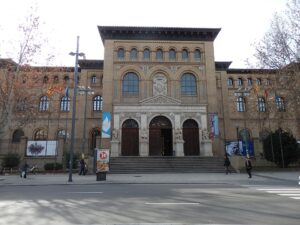
The University of Zaragoza (UZ) is one of the oldest in Spain. Founded in 1474, it is currently made up of a number of research and teaching centres located in historic and modern buildings throughout the three provinces of the Autonomous Community of Aragón (Zaragoza, Huesca and Teruel). It boasts advanced facilities and a wide range of accommodation options. It was recognized as a Campus of International Excellence in 2010. It has been a member of UNITA since 2020. There are over 4,000 teaching staff and some 30,000 students, as well as 170 current research groups covering all scholarly disciplines. The University has historically been renowned for its work in all branches of science and medicine, for which Santiago Ramón y Cajal won the Nobel Prize, but is also internationally recognised in the Social Sciences and Humanities fields. The Congress plenary and parallel sessions will be held in two buildings on the San Francisco Campus (Faculty of Arts and Humanities, and Faculty of Law). Other meetings and panels will be held in the Paraninfo, the historic assembly hall in the University Rectorate building, located about 600 metres from the San Francisco Campus. Both venues are in the city centre and can easily be reached on foot, by bus or by the tram that connects the San Francisco Campus and the Paraninfo, a journey of some five minutes.